
Booking a Mobile Masseuse When You Prefer a Female Therapist
Nov 5, 2026
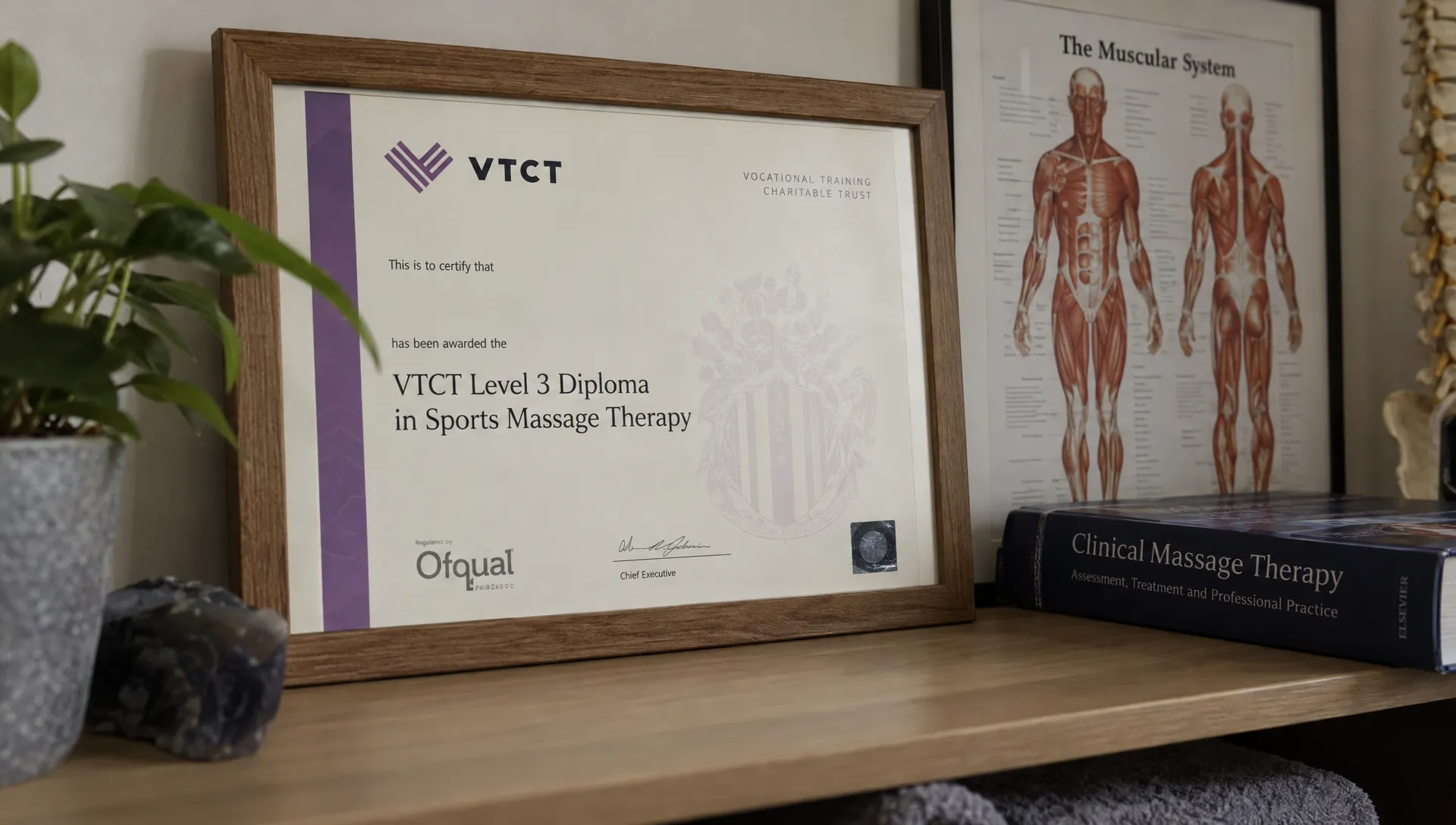
Booking professional massage therapy should involve more than choosing a treatment and reading a few positive reviews. You need to know that the person arriving has relevant training, appropriate insurance and clear professional boundaries. A polished profile or an impressive-looking certificate is only the starting point.
The most useful checks are straightforward: identify the qualification, establish who awarded it, verify any registration claims and confirm that the therapist is trained for your chosen treatment. This guide explains what those checks mean in the UK, which questions to ask and when an unclear answer should make you pause before booking.
Look for a completed qualification that covers anatomy and physiology, client consultation, contraindications, practical massage skills and assessment. Contraindications are circumstances that may make treatment unsuitable or require changes to the approach.
A Level 3 massage qualification is a common starting point in England, but the level alone does not tell you everything. The full qualification title, awarding organisation and practical assessment requirements matter. A short attendance certificate is not equivalent to a qualification that assesses whether someone can work safely with clients.
When checking professional massage therapy credentials, distinguish the organisation that taught the course from the organisation that awarded the qualification. A training school may deliver a course leading to an award from a separate awarding body.
Online learning can support theory, but ask how hands-on skills were taught and assessed. Equally, do not dismiss an overseas qualification simply because its title differs from a UK award. Ask about its content, practical assessment and recognition by the therapist’s insurer or relevant professional register.
Massage therapy is not subject to statutory professional regulation in the UK in the same way as professions such as physiotherapy. There is no single compulsory UK-wide register that every massage therapist must join.
Qualifications, voluntary registration and professional membership serve different purposes:
| Credential or status | What it can help establish | What it does not establish on its own |
|---|---|---|
| Completed massage qualification | Training and assessment in the subjects covered by that award | Competence in every massage style or specialist situation |
| Professional association membership | A relationship with an organisation and obligations attached to that membership category | Statutory regulation or identical entry requirements across all membership grades |
| Voluntary register entry | That the practitioner meets that register’s published entry requirements | Guaranteed treatment results or expertise outside the registered discipline |
| Local authority licence, where required | Compliance with applicable local licensing requirements | The full extent of an individual therapist’s qualifications |
The Complementary and Natural Healthcare Council maintains a voluntary register that includes massage therapy. Its register is accredited by the Professional Standards Authority. You can use the Professional Standards Authority’s website to check information about accredited registers and what accreditation means.
For professional massage therapy, voluntary registration is useful supporting evidence, not a substitute for checking the individual’s training. Professional associations such as the Federation of Holistic Therapists and the Complementary Therapists Association also have their own membership arrangements, so check the precise status being claimed.
Local licensing is a separate question. Requirements and exemptions can vary by council and setting; a business licence should not be presented as proof of an individual’s clinical competence.
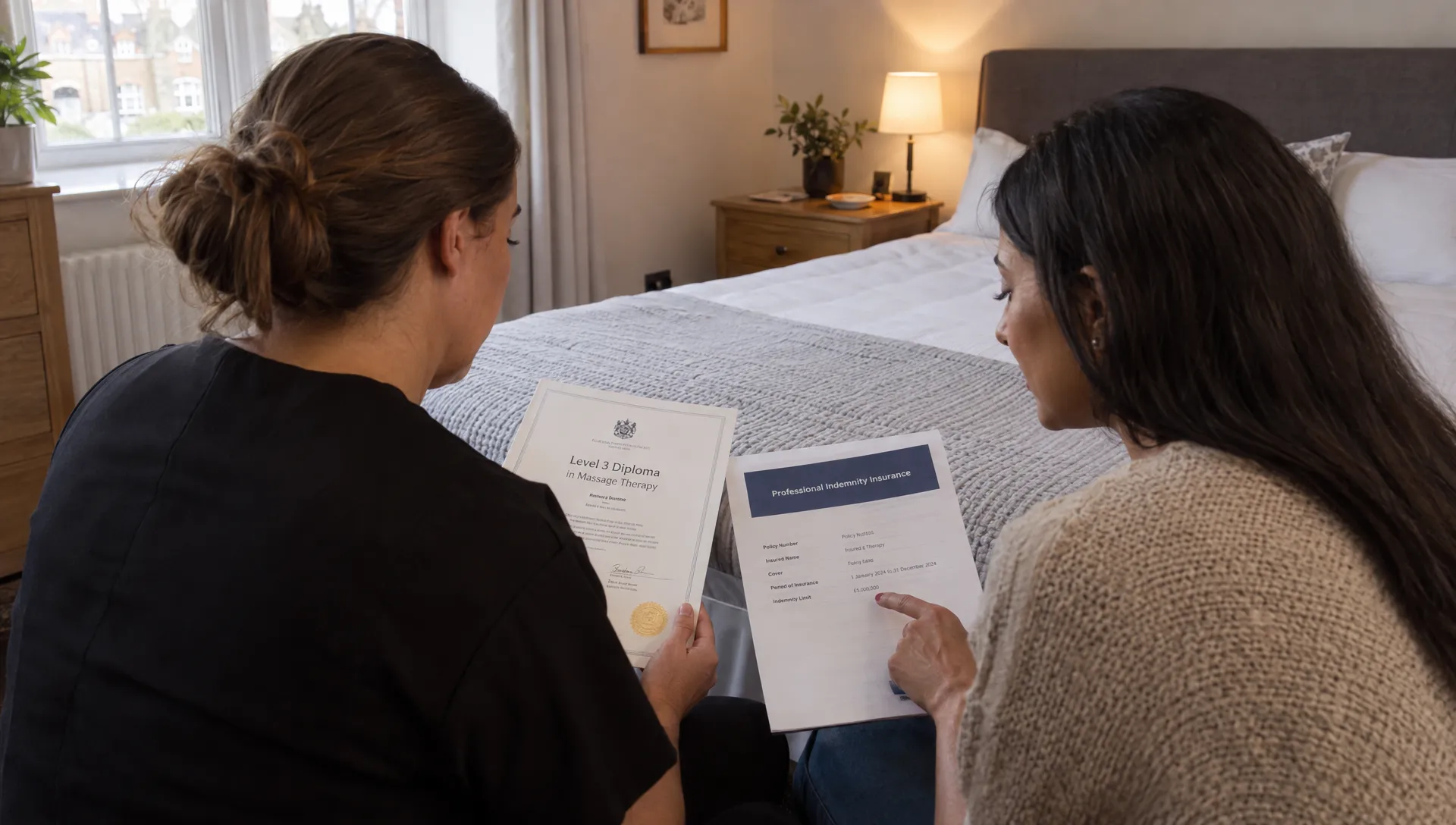
Request the exact qualification title, awarding organisation and completion date. If necessary, ask to see a certificate with unrelated personal information redacted. Check that it records a completed award rather than enrolment, attendance or participation.
The name should correspond to the therapist you are booking. A qualification held by a business owner does not establish the qualifications of everyone working through that business.
For qualifications regulated in England, the Ofqual Register of Regulated Qualifications can help you check the awarding organisation and qualification. It does not confirm that a particular person holds the award. Older qualifications may no longer be available to new learners, so an end date is not automatically evidence that a certificate is invalid.
Qualifications from elsewhere in the UK or overseas may require a different verification route. If the award is unclear, ask the awarding organisation how it can be checked.
If someone claims to be registered, search the register yourself rather than relying on a logo, screenshot or link to a general homepage. Look for the practitioner’s name, listed discipline and current status. Ask for a registration number if you cannot confidently identify the entry.
A register entry for another complementary therapy does not automatically verify massage training. Likewise, a membership badge may refer to a student or associate category rather than the status you assumed.
Checking professional massage therapy claims directly is particularly useful when a profile uses broad language such as “fully accredited”. Ask: accredited by whom, for which qualification or register, and with what current status?
If a register or association offers a complaints process, check how to access it. That provides a clearer route for raising concerns than an unexplained badge on a booking page.
A foundation massage qualification does not, by itself, demonstrate specialist competence in every treatment advertised. Ask about additional training where the session involves pregnancy, cancer care, recent surgery or another situation requiring adaptations.
Treatment names can also be broad. “Deep tissue”, “holistic” and “sports massage” do not tell you exactly which qualification a therapist holds or how they will work with you. Ask what relevant training supports the treatment and whether they regularly work with clients whose needs resemble yours.
You can use Lifeforce’s guide to choosing between massage types for your first booking to clarify the treatment you want before asking about credentials.
A reliable professional massage therapy assessment should connect the therapist’s training with your actual needs, rather than assume that a long treatment menu proves expertise in everything listed.
Ask whether current insurance covers both the treatment itself and public liability. Depending on the working arrangement, cover may be held by the individual therapist, the provider or both. The important point is that the person, treatment and appointment setting are covered.
For a home or hotel visit, confirm that the policy covers mobile work. For a specialist treatment, ask whether that treatment falls within the cover. An insurance document with a recent date is not enough if it relates to a different person or excludes the service being booked.
Insurance supports accountability, but it is not proof of advanced skills or a promise that nothing can go wrong.
The boundaries of professional massage therapy matter just as much. A therapist should explain what they can reasonably offer, acknowledge uncertainty and recommend medical advice when your needs fall outside their training. Promises to cure a disease, diagnose an unexplained symptom or replace prescribed care are reasons to look elsewhere.
Qualifications should translate into appropriate questions. Before treatment, expect a discussion about your goals, relevant medical conditions, injuries, medication and previous reactions to massage.
Pregnancy, recent surgery, cancer treatment or medicines that affect bleeding can change the precautions needed. They do not all mean the same thing, and a therapist should not offer a blanket reassurance without understanding the circumstances. Depending on your situation, advice from your treating clinician may be appropriate.
New or unexplained symptoms should not simply be labelled “muscle tension”. Massage may support comfort or relaxation, but it should not delay medical assessment.
A detailed consultation is one practical sign that professional massage therapy training is being applied rather than merely listed on a profile. You should understand why the proposed treatment is suitable and what, if anything, needs to change.
Before starting, the therapist should explain the areas they propose to treat, the positioning involved and any clothing adjustments. You should have privacy to change and appropriate covering throughout an oil-based treatment, with only the area being worked on uncovered as needed. Some treatments are performed fully clothed.
Consent is ongoing. You can decline work on an area, request lighter pressure, change position or stop the appointment. You do not need to tolerate pain or embarrassment to avoid seeming difficult.
For Lifeforce appointments, treatments take place on a bed. Discuss positioning and comfort beforehand, especially if lying on your front or back is difficult.
A therapist should respond promptly to a request to change pressure. “It has to hurt to work” is not a sound reason to disregard your limits, and unexplained touch outside the agreed treatment is not acceptable.
One missing detail can be an administrative issue. Evasive answers across several basic checks are more concerning. Before booking professional massage therapy, pause if you encounter:
Reviews can add useful context about communication and reliability, but they cannot authenticate a qualification. A high star rating is not a replacement for checking the evidence yourself.
You also do not need to prove that a therapist is unsafe before choosing someone else. If the information remains unclear or you feel pressured to proceed, postponing is a reasonable decision.
Keep your enquiry specific rather than asking only whether the therapist is “qualified”. For example:
Before I book, could you confirm my therapist’s massage qualification and awarding organisation, any current registration details, and whether insurance covers this treatment at my home or hotel? I would also like to discuss a relevant health concern and confirm how pressure, covering and consent are handled.
You do not necessarily need copies of every document. The aim is to receive clear information that you can verify where necessary. Avoid sending detailed medical information through public reviews or open social media comments; ask the provider how to share it privately.
For professional massage therapy, a clear response should make the decision easier without relying on impressive wording or pressure to pay immediately.
Do massage therapists legally need a particular qualification in the UK? There is no single statutory qualification requirement applying to every UK massage therapist. Local licensing conditions, insurers, employers and professional registers may impose their own requirements. For clients, relevant assessed training remains an important safety check regardless of the minimum legal position.
Is professional association membership the same as registration? No. Membership and registration can involve different requirements, even within the same organisation. Check the exact membership grade or register entry and the standards attached to it rather than assuming every badge means the same thing.
Can I verify a therapist’s certificate through Ofqual? Ofqual’s register helps verify regulated qualifications and awarding organisations in England. It is not a public database of individual certificate holders. To resolve doubts about someone’s award, ask the awarding organisation about its verification process, which may require the holder’s consent.
Does a qualification guarantee a good massage? No. Qualifications establish evidence of training, not guaranteed comfort or results. Relevant experience, consultation, communication and respect for consent also matter. You should still be able to adjust or stop treatment, however experienced the therapist is.
Lifeforce provides vetted therapists for home and hotel appointments across London, with online booking and the option to choose your therapist. Start by reviewing the Lifeforce therapist profiles, then ask about any qualification or specialist experience relevant to your needs.
Once those questions are answered, you can book your mobile massage with Lifeforce. Keep the same standards throughout: suitable training, clear information and a treatment that stays within your comfort and consent.